What is Google Discover? The Ultimate 2026 Strategy Guide
Author Box

Sakshi Jaiswal
Sakshi Jaiswal, a digital marketing expert, shares cutting-edge insights and strategies. She enjoys exploring new marketing technologies and tools.
Table of Contents
Why waste hours searching for answers when the news can find you first? Many creators struggle to gain traction in traditional search results, but Google Discover offers a direct path to massive, automated traffic. It delivers personalized content to mobile users based on their habits, effectively solving user intent before they even type a query.
This guide reveals how to optimize content for the 2026 algorithm, focusing on high-quality visuals and topical authority to capture this push-style traffic. Most strategies fail because they ignore visual engagement or E-E-A-T signals. By applying these verified techniques, a website can transform from an invisible archive into a trending powerhouse. It is time to stop chasing keywords and start mastering the art of discovery.
What Is Google Discover?
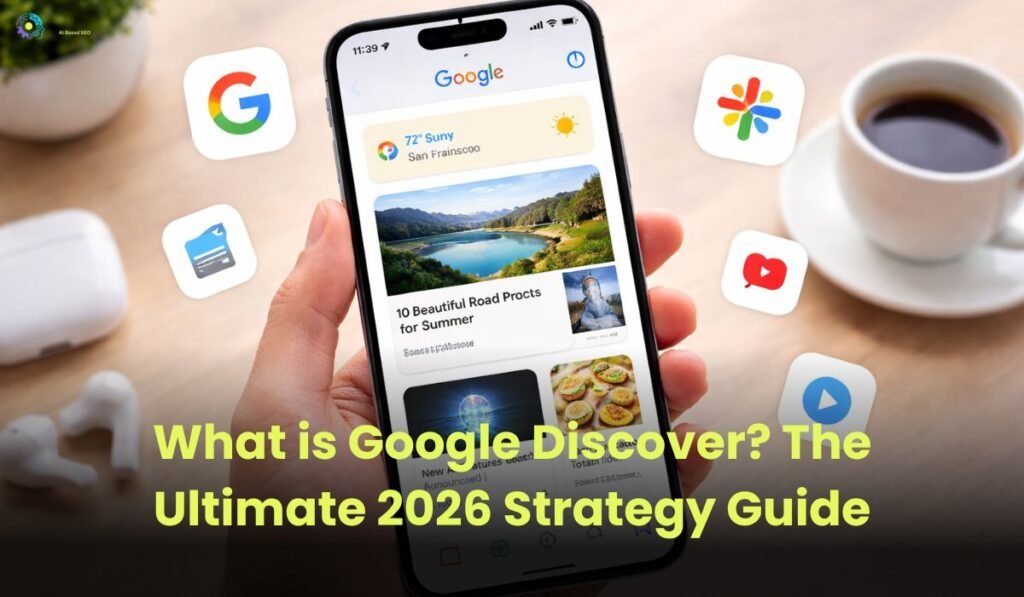
Google Discover is a personalized, AI-driven mobile feed that proactively delivers high-interest content—such as news, articles, and videos—to users based on their search history and interests. Unlike traditional search, which requires a query, Discover uses push technology to surface relevant content before a user even looks for it.
How Does Google Discover Work?
Google Discover works like an advanced recommendation engine. In 2026, it uses Personal Intelligence (driven by models like Gemini) to understand a user’s world. It doesn’t just look at what you searched for yesterday; it looks at:
- Topic Interests: If you frequently read about fintech or cricket, Google builds a semantic map of your interests.
- Location and Context: Following the February 2026 Discover Core Update, Google now prioritizes local relevance. If you are in Delhi-NCR, you are more likely to see news about local events rather than generic global advice.
- E-E-A-T Signals: Google evaluates your Expertise, Experience, Authoritativeness, and Trust. It checks if the author is a real person with a history of writing about the topic.
- Visual Engagement: Discover is a visual-first platform. It scans for high-quality, relevant images that accurately represent the content.
Why is Google Discover Important?
For businesses and publishers, Google Discover is a traffic firehose. While traditional SEO is great for answering specific questions, Discover is great for brand awareness and viral growth.
- Massive Reach: Discover has over 800 million monthly active users. One featured article can result in more traffic in 24 hours than a month of organic search.
- Zero-Click Resistance: Even if a user doesn’t click, seeing your brand in their feed builds Brand Co-occurrence and authority.
- High Engagement: Because the content is personalized, users who do click are usually highly interested in your niche.
- Local Dominance: For local businesses, appearing in the feeds of nearby users is the new way to win the neighbourhood. Partnering with a specialized team like Adwordix can help you tailor your content to capture these local discovery moments.
- Algorithm Favoritism: Once Google identifies your site as a Discover-friendly source, your future posts are indexed and pushed to feeds much faster, creating a snowball effect for your traffic.
How to Optimize for Google Discover in 2026
To get featured, you need to move beyond basic keywords and focus on quality content.
1. The Big Image Rule
In 2026, thumbnails don’t cut it. You need high-resolution images that are at least 1200 pixels wide. Use the max-image-preview: large meta tag to tell Google you have high-quality visuals ready for the feed. Avoid AI-generated slop images; Google’s latest filters prefer authentic, original photography that captures real-world emotions or data.
2. Avoid the Clickbait Trap
Google’s 2026 algorithms are incredibly good at spotting sensationalism. If your headline says you won’t believe what happened, but the article is basic, you will be penalized. Instead, use clear, descriptive titles that promise—and deliver—value.
3. Build Topical Authority
Google prefers to show content from sites that stay in their lane. If you want to be known for digital marketing, publish a cluster of articles on the topic. This signals to Google that you are a trusted source.
4. Entity-Based Tagging
Ensure your content clearly defines Entities (People, Places, Things). In 2026, Discover uses the Knowledge Graph to match your entities with a user’s specific interests. If you provide the best SEO services, ensure your content mentions specific local landmarks, industry tools, and regional trends to help the AI categorize you accurately.
What Type of Content Appears in Google Discover?
Google Discover is far from a standard news ticker; it acts more like a high-end digital concierge. In 2026, the algorithm prioritizes Interest-Graph content over simple keywords. This means the feed is a mix of three primary categories:
- Timely News and Trends: From a sudden shift in the stock market to a viral marketing campaign in Delhi, the feed thrives on what is happening right now.
- Evergreen Value: High-quality guides or opinion pieces often resurface. For instance, a well-structured article on “The Evolution of Digital Marketing” from six months ago might appear for a user who just started searching for marketing degree programs.
- Video and Visual Stories: With the rise of short-form video, Google Discover heavily features Google Web Stories and YouTube Shorts.
- Personalized Hobbyist Content: If a user spends time looking at high-performance cars, Discover will proactively push reviews of the latest electric SUVs or local car shows in the NCR region.
Difference between Google Discover and Google Feed
While many use the terms interchangeably, there is a distinct evolution between the two. The Google Feed was the precursor—a more linear, list-based display of news and weather.
Google Discover is the sophisticated, AI-driven successor. The primary differences lie in the predictive engine. While the old Feed waited for a user to show interest, Discover uses Large Language Models (LLMs) to predict what a user will want to see next.
| Feature | Google Feed (Legacy) | Google Discover (2026) |
|---|---|---|
| Trigger | Recent search history | Holistic user behavior & AI prediction |
| Format | Mostly text-based headlines | Visual-heavy, including Web Stories & Video |
| Logic | Reactive (What you just did) | Proactive (What you might like next) |
| Customization | Basic “follow” topics | Deep “Entity” mapping and interest tuning |
How to Track & Report Google Discover Traffic
You cannot improve what you do not measure. In 2026, tracking Discover traffic requires a two-pronged approach using Google Search Console (GSC) and Google Analytics 4 (GA4).
Using Google Search Console
Once your site reaches a threshold of roughly 1,000 impressions, a dedicated Discover tab will appear under the Performance section in Google Search Console.
- Impressions: How many times your content was seen in a feed.
- Clicks: How many people actually visited your site?
- CTR: The percentage of people who clicked. In Discover, a CTR of 5-10% is considered excellent.
Using Google Analytics 4 (GA4)
Discover traffic often shows up as Direct or Organic in Google Analytics, which can be confusing. To report accurately:
- Go to the Explore tab in GA4.
- Create a custom report filtering by Page Referrer.
- Look for the referrer: android-app://com.google.android.googlequicksearchbox/. This is the signature of the Google App’s Discover feed.
Conclusion
Google Discover has transformed into a powerhouse for growth. By shifting focus toward high-quality visuals and a deeply relevant content marketing strategy, a website becomes a magnet for automated traffic. Success in this landscape requires a commitment to staying ahead of AI-driven updates and consistently providing value to your audience.
Whether you are a small local business or a large publisher, the key to winning is to stop chasing keywords and start mastering the art of discovery. The future of the web is proactive, and those who adapt to this push model today will be the ones leading the market tomorrow.
Table of Contents
Ready to
Work with us?
Frequently Asked Questions
Is Google Discover the same as Google News?
No. Google News focuses on current events and headlines. Google Discover focuses on your personal interests, which might include an article from six months ago if it’s relevant to you today.
Does my content have to be new to appear in Discover?
No. While Discover loves fresh news, it also surfaces “evergreen” content if it matches a user’s current interests. An old post on the best seo services in Gurgaon could resurface if a user starts researching local business growth.
Why did my Discover traffic suddenly stop?
Discover traffic is notoriously “bursty.” It often follows trends. A drop could mean the trend has passed, or your site was affected by a Core Update. Ensure you are consistently producing quality content to stay in the rotation.
Does social media activity affect Discover?
Yes. High engagement on platforms like X (Twitter) or LinkedIn acts as a signal to Google that your content is currently “trending,” making it more likely to be pushed to the Discover feed.
Is Discover available on a Desktop?
As of early 2026, Discover is still primarily a mobile experience through the Google App and Chrome mobile homepages, though Google continues to test desktop versions in certain regions.