How Search Engines Work? Crawling, Indexing, and Ranking
Author Box

Sakshi Jaiswal
Sakshi Jaiswal, a digital marketing expert, shares cutting-edge insights and strategies. She enjoys exploring new marketing technologies and tools.
Table of Contents
Building a website without understanding the mechanics of search is like printing a book and hiding it in a basement where no one can find it. Mastering the process of crawling, indexing, and ranking ensures that search engines discover your pages, store them in their database, and present them to the right audience at the right time.
Many businesses struggle with invisible content because they overlook the technical journey a webpage takes before appearing on Google. This comprehensive guide simplifies the complex lifecycle of a URL, offering a roadmap to bypass common crawl traps and indexing delays. Based on years of analyzing search behavior, it is clear that technical health is the foundation of visibility. By the end of this article, readers will have the exact strategies needed to optimize their site for maximum search engine performance.
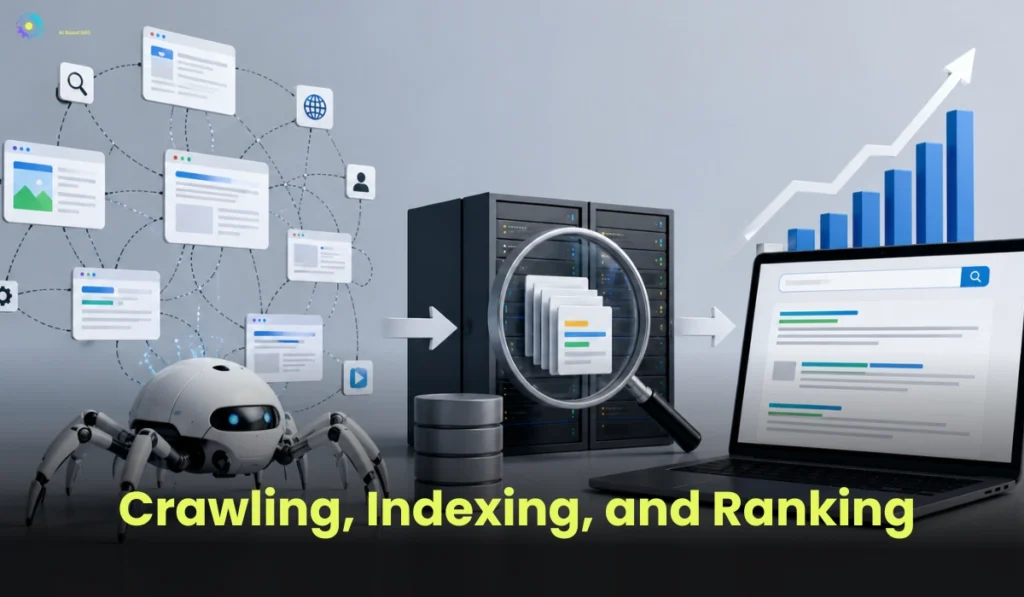
What Is the Journey of a Webpage Through Crawling, Indexing, and Ranking?
1. What is Search Engine Crawling?
Crawling serves as the essential foundational step where search engine bots, like Googlebot, act as advanced digital scouts. They navigate the vast, ever-expanding web by following intricate paths created by hyperlinks.
By hopping from one link to another, these crawlers discover new pages and updated content, effectively mapping out the internet’s structure to ensure no valuable information remains hidden from the search engine’s massive global reach.
- URL Discovery: Bots start with a list of URLs from past crawls and sitemaps provided by webmasters.
- Following the Trail: As they visit these pages, they use links on those pages to discover new URLs, effectively crawling through the web’s interconnected web.
- The Crawl Budget: Search engines don’t have unlimited resources. They decide how much time to spend on a site based on its speed, reliability, and popularity. Using Technical SEO services ensures that this budget is spent on your high-value pages rather than broken links or duplicate content.
- Detection of Changes: If a bot revisits a page and notices the Last Modified header has changed, it will re-process that page to capture the new information.
2. What is Indexing in SEO
Once a bot discovers a specific page, it must determine if the content is truly worthy of being stored. This is the indexing phase, where the raw data is meticulously analyzed and turned into a structured entry within a massive database.
Think of it as a digital library where Google organizes billions of web pages by topic and relevance, allowing for near-instant retrieval when a user performs a search.
- Content Analysis: The engine renders the page (much like a browser does) to see what a user sees. It analyzes text, images, and video to understand the topic.
- Categorization: The page is filed under specific categories and keywords. This is why on-page SEO services are crucial; they help the engine accurately categorize your content.
- Exclusion Factors: Not every page makes the cut. If a page is a duplicate of another, has a noindex tag, or provides very little value (thin content), the engine may choose to ignore it.
- Storage in the Index: If the page passes the quality check, it is added to the Index—a digital library containing hundreds of billions of webpages.
3. What is Ranking in SEO
Ranking is the most visible part of the journey, occurring when a user types a specific query into a search bar. The search engine doesn’t search the live web; it searches its pre-built Index to find the best matches.
Using complex algorithms, it evaluates hundreds of signals—like keyword relevance and site authority—to decide which pages appear at the very top, ensuring users find the most helpful answers immediately.
- Algorithmic Sorting: In a fraction of a second, algorithms sift through billions of indexed pages to find the best match.
- Ranking Signals: Hundreds of factors are weighed, including keyword relevance, site speed, mobile-friendliness, and the number of quality backlinks.
- User Intent Matching: The engine looks for the meaning behind the search. For example, if a user searches for the best SEO services in Gurgaon, the engine prioritizes local service providers over general blog posts.
- Constant Evolution: Rankings are not permanent. As new content is indexed and user behavior changes, the order of results shifts to ensure the most helpful information remains at the top.
How Does Google Discover Content Through Crawling?
Crawling is the process by which search engines send out a team of robots, often called spiders or crawlers, to find new and updated content. Content can vary; it can be a webpage, an image, a video, or a PDF. Regardless of the format, content is discovered by links.
The Role of the Crawl Budget
Search engines do not have infinite resources. They assign a crawl budget to every site, which is the number of pages a bot will crawl on a specific day. Large sites must optimize this budget to ensure important pages aren’t ignored.
- Sitemaps: Providing an XML sitemap acts as a direct invitation for bots to visit specific URLs.
- Internal Links: These are the paths crawlers follow. A page with no links pointing to it is known as an orphan page and is rarely discovered.
- Robots.txt: This file tells bots where they are not allowed to go, preserving the crawl budget for high-value pages.
Crawling is the discovery stage where search engine bots (like Googlebot) follow links to find new or updated content. To optimize this, ensure a clean site structure, use a sitemap, and avoid blocking essential resources in your robots.txt file, allowing bots to navigate your site efficiently.
Also Read: SEO crawling to speed up discovery.
What Happens During the Indexing Phase?
Once a page is crawled, the search engine tries to understand what the page is about. This is the indexing phase. The engine processes the text, images, and overall layout to categorize the information in its Index—a digital library of the entire web.
Factors Influencing Crawling and Indexing
Effective crawling and indexing require a site to be technically sound. If a server is slow or a page has noindex tags, the process stops. Utilizing technical SEO services is often the best way to ensure there are no barriers in this phase.
| Indexing Element | Impact on SEO |
|---|---|
| Canonical Tags | Prevents duplicate content from confusing the index. |
| Alt Text | Helps bots see and index images for visual search. |
| Mobile-First | Google primarily indexes the mobile version of a site. |
| Structured Data | Provides explicit clues about the meaning of a page. |
Also Read: What is indexing in SEO and why it matters
How Does the Algorithm Decide the Final Ranking?
Ranking is the final goal. When a user types a query, the search engine sifts through its index to find the most relevant and high-quality results. This happens in milliseconds and involves hundreds of factors.
The Core Pillars of Ranking
- Relevance and Intent Matching: How well does the content answer the user’s specific intent? If a user searches for how to fix a leak, the algorithm prioritizes instructional guides over product sales pages.
- Authority and Backlinks: Does the site have high-quality backlinks from other trusted, industry-related sources? A link from a major news outlet or a respected trade journal acts as a vote of confidence for your content.
- User Experience (UX): Is the site fast, secure (HTTPS), and easy to navigate on mobile? High bounce rates tell the algorithm that users didn’t find what they were looking for, which can lead to a drop in rankings.
- Freshness and Accuracy: For news, trending topics, or medical advice, the most recent and factually verified information ranks higher.
- E-E-A-T (Experience, Expertise, Authoritativeness, Trustworthiness): Google’s quality raters look for content created by people with real-world experience. Showing who is behind the content is now a major ranking signal.
To achieve a top position, many businesses in competitive hubs seek the best SEO services in Gurgaon to refine their content and technical profiles. High rankings require a blend of data-driven strategy and high-quality writing.
How Do AEO and GEO Change the Ranking Game?
In 2026, ranking is no longer just about blue links on a screen. Answer Engine Optimization (AEO) and Generative Engine Optimization (GEO) are the new frontiers. These focus on how AI models like ChatGPT or Google Gemini pull information to answer verbal or conversational prompts.
Navigating the AI-Driven Search Landscape
As search shifts from typing keywords to asking questions, the way content is structured must evolve. AI engines don’t just want a page; they want a specific, extractable answer.
- Concise Direct Answers: Content should lead with clear, 40-60-word summaries of the main topic. This makes it easier for AI to select your content for a Featured Snippet or a spoken response.
- Conversational Tone: Writing as if explaining a concept to a peer helps AI models process the data more naturally. This human-like flow is essential for appearing in voice searches and LLM (Large Language Model) citations.
- Structured Facts and Data: Tables, bullet points, and numbered lists are easier for AI to scrape and present as a definitive answer. Schema markup helps engines understand the relationship between different facts on your page.
- Source Credibility: GEO models prioritize sources that are frequently cited by others. This reinforces the need for strong on-page SEO services combined with a robust digital PR strategy.
Example: When a user asks an AI, “What is the best way to improve site speed?” the engine will look for a site that provides a clear, numbered list of steps (Technical SEO)and cites reputable sources like Google’s web dev blogs.
Conclusion
Understanding crawling, indexing, and ranking is the only way to ensure a digital presence survives in a competitive market. By facilitating easy discovery for bots, providing clear context for indexing, and delivering unmatched value for ranking, any website can climb the search engine results page. Consistency in technical health and content quality remains the gold standard for long-term online success.
Table of Contents
Ready to
Work with us?
Frequently Asked Questions
How long does it take for Google to index a new page?
It can take anywhere from a few hours to several weeks. To speed up the process, submit the URL manually through Google Search Console and ensure it is linked within your site’s main navigation.
Why is my page crawled but not indexed?
This usually happens if the content is deemed too similar to existing pages, lacks sufficient value, or has technical errors. Improving content quality and checking for canonical tags can often solve this.
Can I rank without being indexed?
No. Indexing is a prerequisite for ranking. If your page is not in the search engine’s database (the index), it cannot be retrieved and displayed to users in search results.
What is a crawl trap?
A crawl trap is a structural issue, like an infinite loop of calendar links or filter parameters, that causes a bot to waste time crawling useless pages, preventing it from finding your important content.
How do backlinks affect the crawling process?
Backlinks act as bridges. When a high-authority site links to yours, it signals to crawlers that your page is important, often leading to more frequent crawling and faster indexing of your content.