EEAT in SEO: The Complete Guide to Better Rankings
Author Box

Sakshi Jaiswal
Sakshi Jaiswal, a digital marketing expert, shares cutting-edge insights and strategies. She enjoys exploring new marketing technologies and tools.
EEAT in SEO helps explain why some content earns lasting search visibility while other pages struggle to gain trust. Search engines are no longer looking only at keywords, backlinks, or how much content a website publishes. They also consider whether information is genuinely useful, accurate, backed by relevant experience or expertise, and presented by a source readers can trust.
But what does E-E-A-T really mean, and how can you use it to strengthen your SEO strategy without treating it like a ranking score? From the evolution of E-A-T in SEO to the role of Experience, Expertise, Authoritativeness, and Trustworthiness, this guide explains what E-E-A-T means, why it matters, and how to demonstrate it across your website.
Whether you run a business website, publish educational content, manage an e-commerce store, or create YMYL content, the goal is the same: give people information they can rely on. By the end of this guide, you’ll know how to build stronger credibility, demonstrate genuine expertise, improve content quality, and create a website that is better positioned for modern search and AI-driven discovery.
What Is E-E-A-T in SEO?
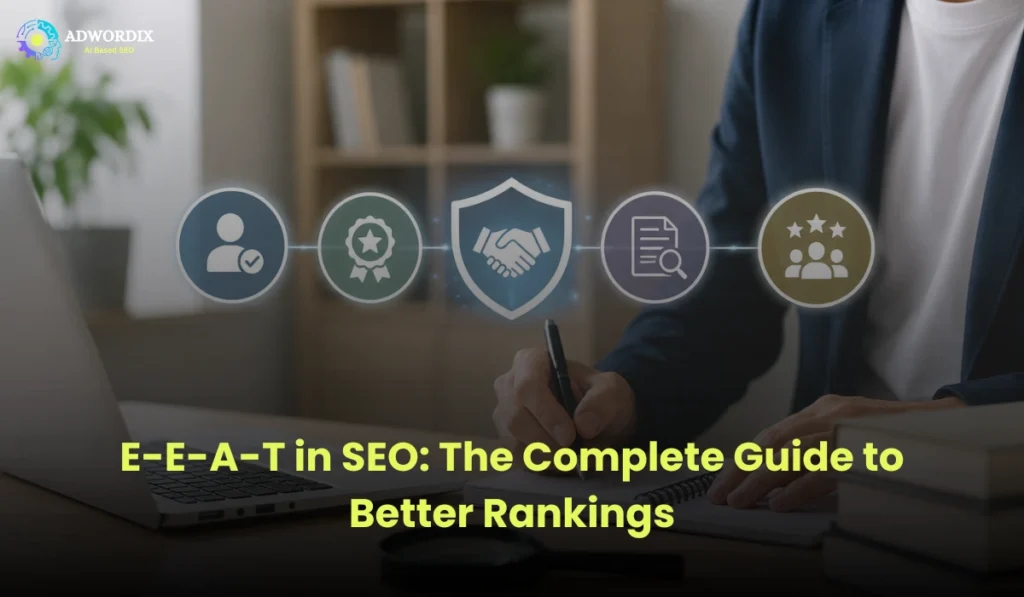
E-E-A-T stands for Experience, Expertise, Authoritativeness, and Trustworthiness. It is a core concept from Google’s Search Quality Rater Guidelines, which human evaluators use to grade search result quality. While not a single code-based ranking metric, E-E-A-T serves as a structural framework for evaluating content credibility and website quality.
E-E-A-T Framework = Can this content be trusted, and is the creator qualified to write it?
What Does E-E-A-T Stand For?
E-E-A-T Element | What It Means | Practical Application |
Experience | First-hand, real-world experience | Screenshots, personal testing, original photos |
Expertise | Formal knowledge, skills, or qualifications | Professional background, credentials, and subject depth |
Authoritativeness | Industry recognition and overall reputation | Citations, quality backlinks, media mentions |
Trustworthiness | Accuracy, transparency, and safety | Secure site, clear policies, accurate data |
Is E-E-A-T the same as E-A-T?
No. For years, marketers focused on E-A-T SEO (Expertise, Authoritativeness, Trustworthiness). In December 2022, search guidelines added an extra “E” for Experience.
The journey of Google E-E-A-T shows how search habits are evolving. Nowadays, readers crave more than just textbook knowledge; they’re looking for real-life tips from folks who have genuinely tried a product, tested a strategy, or experienced an event firsthand. By blending SEO know-how with genuine expertise, search engines can spotlight authentic, relatable content that resonates more than just standard summaries.
Why Was Experience Added to E-A-T?
First-hand experience gives content a level of authenticity that theoretical knowledge cannot replicate. Consider how experience changes different types of content:
- Product Reviews: A review written by someone who physically unboxed, tested, and stress-tested a product provides far more value than a summary of a manufacturer’s spec sheet.
- Travel Guides: Insights written by someone who visited a city, detailing actual walking times and local nuances, outperform scraped travel itineraries.
- Technical Tutorials: A step-by-step guide written by an engineer who encountered and fixed real bugs is far more helpful than generic documentation summaries.
- Medical Information: Patient personal stories offer unique lifestyle context, though clinical recommendations still require qualified medical review.
Formal credentials are not mandatory for every single search query. For many everyday topics, real personal experience provides the exact context users are searching for.
Why Is EEAT Important for SEO?
Search engines aim to deliver safe, accurate, and highly relevant information. Poor advice on financial investments, medical symptoms, or legal procedures can harm users physically or financially. Emphasizing E-E-A-T helps search algorithms filter out unverified or misleading content.
E-E-A-T and Content Quality
High-performing web pages follow a clear quality chain:
Relevant content → accurate information → useful experience → credibility → trust.
When you publish high-quality content created by experienced writers, user engagement naturally rises. Readers stay longer on your pages, explore related posts, and share your resources. These positive user interactions signal strong overall content quality to search algorithms.
High E-E-A-T & Quality
↓
Better User Engagement & Natural Mentions
↓
Stronger Search Visibility & Sustainable Rankings
E-E-A-T and Search Visibility
Building trust helps protect your website from broad core algorithm updates. Search systems evaluate quality signals across whole sites, not just individual pages. Maintaining high standards across your entire publication helps secure steady organic search traffic over time.
Does E-E-A-T Directly Affect Google Rankings?
No, E-E-A-T is not a direct, individual ranking factor or an algorithmic score.
There is no technical database metric labeled “E-E-A-T score.” Instead, search engines use hundreds of automated signals to identify pages that demonstrate experience, expertise, authority, and trust. E-E-A-T serves as a guiding concept for human quality raters, whose evaluations help engineers calibrate ranking algorithms.
The Four Parts of E-E-A-T Explained
Understanding the four elements of E-E-A-T helps you audit and upgrade your existing content strategy systematically.
E-E-A-T Framework
Experience → First-hand testing and real-world use
Expertise → Subject knowledge, skills, and qualifications
Authoritativeness → Industry recognition, reputation, and mentions
Trustworthiness → Accuracy, transparency, safety, and credibility
Trustworthiness is the foundation that connects all four elements.
1. Experience: Show First-Hand Knowledge
Experience answers a simple reader question: “Has the author actually done what they are writing about?“
To demonstrate real experience in your content, include the following:
- Original Media: Photos, video walk-throughs, or screenshots taken during real testing.
- Original Data: Case studies, performance metrics, and documented results.
- Personal Insights: Specific challenges faced, unexpected findings, and practical lessons learned.
- Implementation Steps: Clear instructions built from actual execution rather than theoretical guidelines.
2. Expertise: Demonstrate Subject Knowledge
Expertise focuses on the credentials, skills, and deep subject knowledge of the content creator.
While experience means “I have done this,” expertise means “I have the formal training or deep skill to explain this accurately.”
To show expertise, ensure your content includes:
- Detailed author bios highlighting industry background, degrees, or certifications.
- In-depth explanations that answer complex follow-up questions.
- Formal review procedures by qualified experts for sensitive topics.
- Accurate terminology and clear references to verified industry standards.
3. Authoritativeness: Build Recognition
Authoritativeness reflects your brand and author reputation within your specific niche. It measures how much others in your field view your site as a primary go-to resource.
Authority works at three connected levels:
- The Creator: Is the author a recognized voice in their field?
- The Content: Is this specific article cited and linked to by other industry sites?
- The Website/Brand: Is the overall platform recognized as an established industry leader?
You build authority by earning press coverage, publishing original research, securing high-quality backlinks, and maintaining consistent topical coverage across your niche.
4. Trustworthiness: The Most Important Foundation
Trust is the central core of the E-E-A-T framework. Experience, expertise, and authority mean little if your website feels unsafe, deceptive, or inaccurate.
To build and maintain site-level trustworthiness, focus on:
- Factual Accuracy: Thoroughly verify claims, statistics, and figures.
- Clear Ownership: State who owns the website and display clear contact details.
- Website Security: Maintain HTTPS encryption and robust user data protection.
- Transparent Business Policies: Clearly display privacy policies, terms of service, and refund details.
- Editorial Standards: Disclose affiliate links, sponsored partnerships, and editorial guidelines.
How to Demonstrate E-E-A-T on Your Website
Transitioning from understanding E-E-A-T to putting it into practice requires clear structural updates across your site.
Create Detailed Author Bios
Every piece of content on your site should have a clear, attributable author. Move past generic “Admin” bylines and build comprehensive author profile pages.
Your author profile pages should feature:
- The author’s full legal or professional name and current title.
- A clear summary of their background, industry experience, and qualifications.
- Links to active professional profiles (e.g., LinkedIn, professional associations).
- Links to other publications, research papers, or articles they have authored.
Show Who Created and Reviewed the Content
For technical, legal, or health-related topics, separate content creation from editorial oversight. Display clear bylines indicating accountability:
Written by: [Author Name, Qualification] | Reviewed by: [Expert Name, Credential]
Last Updated: [Current Month, Year]
This clear split shows search engines and visitors that your content undergoes rigorous editorial review before publishing.
Add First-Hand Experience to Content
Avoid publishing generic summaries of top-ranking search results. Upgrade your pages by adding real-world proof points:
- Include custom screenshots showing software configurations or technical workflows.
- Add quotes from internal subject matter experts or industry specialists.
- Share specific metrics from real projects, including what failed and how you fixed it.
- Embed original videos demonstrating products or physical procedures in real time.
If your team lacks the bandwidth to create in-depth, original articles internally, partnering with professional content writing services can help translate your internal expertise into polished, publishable assets.
Support Claims With Reliable Sources
Back up every major claim, statistic, or data point with citations to trustworthy external sources:
- Link directly to peer-reviewed studies, government databases, and academic institutions.
- Cite original surveys and industry reports rather than secondary blog summaries.
- Reference official vendor documentation when explaining technical features.
Avoid cluttering your pages with excessive links. Focus on pointing readers to authoritative sources that validate key data points.
Make Your Business Information Transparent
A trustworthy website clearly shows who runs it. Make fundamental business details easy for visitors to find:
- Add a dedicated About Us page detailing your company history, mission, and leadership team.
- Provide an easy-to-find Contact Us page with physical addresses, phone numbers, and direct email contacts.
- Make standard legal documents, including privacy policies, terms of use, and return policies, easy to find from your site footer.
How to Improve E-E-A-T in SEO
Improving E-E-A-T across your site requires an ongoing commitment to content quality and brand reputation management.
E-E-A-T Improvement Action Plan
- Audit Existing Content
- Upgrade Author Signals
- Add Original Research & Data
- Strengthen Brand Authority & Backlinks
- Maintain Regular Content Audits
Audit Your Existing Content
Start by evaluating your published content to fix quality gaps:
- Identify Missing Bylines: Find articles published under generic author accounts and assign them to verified writers.
- Review Factual Accuracy: Check outdated statistics, broken outbound links, and old claims that no longer apply.
- Evaluate Depth: Identify short, generic posts that lack original insights or real-world examples.
Improve Author and Reviewer Signals
Strengthen your brand’s expertise signals by formalizing your editorial process:
- Connect author profile pages using structured data (author schema markup).
- Feature real internal experts on your team page and blog posts.
- Include detailed author bios on all guest posts or external contributions.
If you want to scale your content production while maintaining high editorial standards, working with a specialized content marketing services team ensures your articles stay aligned with search quality standards.
Replace Generic Content With First-Hand Insights
Transform generic, surface-level articles into comprehensive, expert-led guides:
- Replace generic advice with documented case studies and real project examples.
- Replace stock photography with original photos, diagrams, and custom graphics.
- Include custom tables, decision matrices, and clear comparison frameworks.
Strengthen Your Brand’s Authority
Building off-site authority requires earning genuine recognition within your industry niche:
- Execute digital PR campaigns built around original data, proprietary research, or industry surveys.
- Contribute expert quotes and commentary to reputable news outlets and industry publications.
- Earn high-quality backlinks naturally by publishing useful infographics, tools, and research reports.
Building off-site authority requires an integrated search strategy. Partnering with an experienced SEO company in Delhi can help align your technical setup, content strategy, and link-building efforts with modern E-E-A-T expectations.
Strengthen Website Trust
Audit your technical setup to ensure visitors feel safe sharing information on your site:
- Install and maintain valid SSL security certificates across all subdomains (HTTPS).
- Ensure user payment options use secure, PCI-compliant payment gateways.
- Make customer support channels accessible via live chat, email, or telephone.
- Display real user reviews, verified testimonials, and trust badges on high-intent landing pages.
Keep Content Updated
Search algorithms favor up-to-date resources over outdated pages. Build a recurring content review schedule to keep your site fresh:
- Update outdated metrics and references with current industry data.
- Re-test product recommendations to confirm your top picks are still accurate.
- Add fresh sections covering new industry trends or technology shifts.
- Update the “Last Reviewed” date on refreshed articles to show active maintenance.
E-E-A-T for Different Types of Websites
E-E-A-T expectations vary depending on your website’s focus and topic area.
E-E-A-T by Website Type
- Health & Medical: Credentials and qualified medical review.
- Finance & Investing: Expert credentials and clear disclosures.
- E-Commerce: Verified reviews and transparent return policies.
- Local Business: Consistent business details and real-world proof.
- Blogs & Creators: First-hand experience and content transparency.
E-E-A-T for Health and Medical Websites
Health platforms carry strict quality standards because inaccurate medical advice can directly impact reader safety:
- Articles must be written or reviewed by qualified medical professionals (e.g., MDs, registered dietitians).
- Advice should cite peer-reviewed clinical studies and official health organizations.
- Content should include clear medical disclaimers emphasizing that online articles cannot replace professional medical care.
E-E-A-T for Financial Websites
Financial topics require strict accuracy to protect readers’ money:
- Investment, tax, and mortgage guides should be reviewed by qualified financial planners or certified accountants.
- Articles must include clear financial risk disclosures.
- Content must reflect current laws, regulations, and market rates.
E-E-A-T for E-Commerce Websites
Online stores build trust by making the purchasing process clear and safe:
- Product descriptions should highlight real specifications and practical usage details.
- Customer reviews should feature verified buyer tags and honest product feedback.
- Shipping details, return policies, and customer support channels should be clear and easy to find.
E-E-A-T for Local Businesses
Local service providers prove E-E-A-T by showing real work within their communities:
- Maintain identical Name, Address, and Phone number (NAP) details across local directories and your Google Business Profile.
- Feature real photos of your team, fleet vehicles, completed job sites, and offices.
- Publish client testimonials and local case studies detailing specific projects in your area.
E-E-A-T for Bloggers and Content Creators
Independent bloggers do not always need formal degrees, but they must demonstrate authentic experience:
- Share personal experiences, unboxing photos, and detailed product testing observations.
- Be open about affiliate relationships, sponsored products, and free samples.
- Maintain a detailed About page detailing your background and interest in the niche.
How EEAT Supports YMYL SEO
Search engines apply strict quality standards to YMYL (Your Money or Your Life) topics.
YMYL Topics
- Health
- Financial
- Legal
- Safety
Strictest E-E-A-T Standards: All four areas require a higher level of accuracy, expertise, evidence, and trust.
What Is YMYL?
YMYL content includes any topic that directly impacts a reader’s health, financial security, personal safety, or legal status. Examples include medical advice, investment guidance, legal rights, and emergency preparedness.
Why Does Trust Matter More for YMYL Topics?
An inaccurate article about movie trivia causes no real harm. However, an inaccurate article about drug dosages or tax strategies can lead to serious physical or financial consequences. Because the risk of harm is high, search engines require exceptionally high proof of experience, expertise, and trustworthiness before ranking YMYL pages.
How to Build Stronger E-E-A-T for YMYL Content?
If your website handles YMYL topics, use this strict publishing checklist:
Qualified Expertise + Verified Evidence + Real Experience + Total Transparency = YMYL Compliance
- Verify Credentials: Require qualified experts to author or review all YMYL articles.
- Cite Primary Sources: Support all claims with direct links to academic journals, legal codes, or official government databases.
- Audit Regularly: Review YMYL content every 6–12 months to verify that all recommendations match current professional standards.
E-E-A-T, AI Content, and AI Search
The surge in generative AI tools has made scaling content creation easier than ever. However, it also highlights why human-backed E-E-A-T signals are crucial for search visibility.
Does AI-Generated Content Have E-E-A-T?
AI tools can quickly summarize existing web pages, but they lack real personal experience. An AI model cannot physically test a sleeping bag, manage a live software launch, or feel medical symptoms.
Relying on raw AI output without human oversight creates major quality and trust risks:
- Generative Hallucinations: AI tools can confidently present false data, outdated statistics, or fake citations as facts.
- Generic Advice: Unassisted AI content often repeats surface-level points without adding new insights.
- Lack of Attribution: AI tools do not have personal credentials or professional accountability.
Using AI to draft outlines or organize ideas is fine. However, high-ranking pages require human experts to verify facts, add real-world experience, and edit the final text.
If your internal team struggles to maintain this balance, partnering with professional content writing specialists ensures your articles sound authentic, hit search intent, and meet search engine quality standards.
How Can E-E-A-T Support AI Search Visibility?
Modern AI search tools and overview features rely on clear content structure and strong trust signals to choose source citations.
High-Trust Web Sources ─► [AI Search Engines] ─► Featured Citations & Overviews
Websites with strong E-E-A-T signals, such as verified authors, original research, and clear citations, are far more likely to be used as trusted sources for generative AI summaries.
How to Make Content Easier for AI Systems to Understand?
To make your expert content readable for both human visitors and AI search systems:
- State Answers Clearly: Provide direct, 40-60-word summaries immediately following section headings.
- Use Structured Data: Add Schema markup (Article, Author, Organization, FAQPage) so machine systems can map relationships clearly.
- Maintain Topical Focus: Organize your content into logical topic clusters to build clear site authority.
- Highlight Original Insights: Present original data points, survey findings, and personal testing clearly using custom tables and bullet lists.
How to Measure E-E-A-T in SEO?
Because E-E-A-T is a framework rather than a single metric, you cannot open a tool and check a single “E-E-A-T score.” Instead, you measure E-E-A-T by tracking proxy metrics that reflect content quality, brand authority, and user trust.
Key Metrics for Tracking E-E-A-T Performance
Focus Area | Tracked Metric | What It Indicates |
Content Quality | Engagement Rate & Time on Page | Indicates readers find your content helpful and thorough. |
Authoritativeness | Branded Search Volume | Measures how often users search for your brand directly. |
Industry Reputation | Referral Traffic & Press Mentions | Shows other publications view your site as an authority. |
Trustworthiness | Conversion & Churn Rates | Reflects user confidence in your recommendations and services. |
Organic Visibility | Keyword Rankings for YMYL Terms | Demonstrates search algorithms trust your page recommendations. |
Can You Get an E-E-A-T Score?
No. There is no official Google E-E-A-T score. Any platform claiming to calculate your site’s exact “E-E-A-T score” is using an unofficial third-party metric. Focus on building real expert content, earning authentic mentions, and maintaining transparent business practices rather than chasing a synthetic score.
Common E-E-A-T Mistakes to Avoid
Many site owners make costly mistakes when attempting to optimize for E-E-A-T. Avoid these frequent errors:
- Treating E-E-A-T as a Code-Based Ranking Score: Rewriting pages just to add buzzwords, rather than making meaningful improvements to accuracy, author credentials, and content depth.
- Fabricating Author Profiles: Creating fake stock-photo author bios. Search systems and users can spot fake profiles, damaging site trust.
- Publishing Low-Quality AI Drafts: Publishing raw AI-generated text without expert review, fact-checking, or original insights.
- Making Unsupported Claims: Stating bold statistics or medical claims without linking to credible primary sources.
- Hiding Site Ownership: Failing to provide clear contact information, business details, or editorial guidelines.
- Buying Irrelevant Links: Purchasing cheap backlink packages instead of building authentic industry recognition through digital PR and original content.
- Ignoring Website Security: Expecting high trust scores while running an unencrypted (HTTP) site with technical errors and broken pages.
E-E-A-T SEO Checklist
Use this quick checklist to audit your pages and verify your site meets key search quality standards:
Experience
- Does the content include original photos, screenshots, or videos showing real testing?
- Are there personal observations, project metrics, or real case studies included?
- Does the text explain how a process was completed, rather than just describing it theoretically?
Expertise
- Is the article attributed to a verified author with relevant background or credentials?
- Are complex terms explained accurately using appropriate industry terminology?
- Has sensitive or YMYL content been reviewed by a qualified subject-matter expert?
Authoritativeness
- Does the page link out to authoritative primary sources and industry studies?
- Is the website earning natural mentions and backlinks from reputable niche sites?
- Does the site provide deep, comprehensive coverage across its core topics?
Trustworthiness
- Is the site secured using HTTPS encryption?
- Are direct contact details, physical business addresses, and leadership details easy to find?
- Are affiliate links, sponsorships, and editorial guidelines disclosed clearly?
- Is the content free from unsupported claims, broken links, and outdated data?
How to Build an E-E-A-T Focused SEO Strategy
Integrating E-E-A-T into your broader marketing strategy requires a clear, repeatable process.
1. Audit ──► 2. Demonstrate ──► 3. Strengthen ──► 4. Verify ──► 5. Maintain
- Audit Existing Assets: Review your current website to identify pages lacking author attribution, containing outdated claims, or needing original data.
- Demonstrate Real Expertise: Feature internal subject-matter experts in your articles, record their insights, and build detailed author profile pages.
- Strengthen Brand Reputation: Publish original surveys, industry research, and valuable tools that earn natural media citations and authoritative backlinks.
- Verify Site-Level Trust: Update your legal documents, secure user entry forms, and make customer support channels easy to find across your site.
- Maintain Regular Reviews: Re-evaluate high-priority pages every 6–12 months to update statistics, re-test product advice, and confirm factual accuracy.
If executing an end-to-end optimization framework feels daunting internally, partnering with a full-service SEO company in Delhi gives you the expertise needed to scale your organic performance sustainably.
E-E-A-T vs. Other SEO Priorities
E-E-A-T is a critical component of search strategy, but it does not replace core technical and structural SEO foundations.
SEO Discipline | Main Purpose | How It Works Alongside E-E-A-T |
Search Intent | Answer the user’s specific query directly | Ensures your expert insights directly address what the user is looking for. |
Technical SEO | Helps search engines crawl and index pages | Ensures search engines can discover, access, and index your expert content. |
On-Page SEO | Optimizes tags, headers, and page structure | Use a clean layout to make your research and insights easy for users to read. |
E-E-A-T | Proves credibility, expertise, and trust | Builds the trust required to rank competitively for high-value terms. |
Internal Linking | Connects related information across your site | Distributes authority and connects related topic clusters across your site. |
E-E-A-T works best as a layer that enhances your existing technical, structural, and content marketing efforts.
Build Trust, Not Just Rankings
E-E-A-T in SEO is about creating content that people can rely on and search engines can better understand. By demonstrating real experience, relevant expertise, genuine authority, and strong trust signals, your website can build stronger content quality and long-term search visibility. Remember, E-E-A-T is not a score to chase or a shortcut to rankings; it is a framework for creating useful, credible, and people-first content.
The best approach is simple: show what you know, prove what you have experienced, support your claims, and make your website transparent and trustworthy. Whether you run a business site, e-commerce store, blog, or YMYL platform, consistently applying these principles can strengthen your SEO foundation and help your content stand out in both traditional and AI-driven search.
Table of Contents
Ready to
Work with us?
Frequently Asked Questions
What is the difference between E-A-T and E-E-A-T?
E-A-T originally focused on expertise, authoritativeness, and trustworthiness. In December 2022, Google updated the acronym to E-E-A-T by adding an extra “E” for Experience, emphasizing the value of first-hand, real-world experience in content creation.
Is E-E-A-T a direct Google ranking factor?
No, E-E-A-T is not a single direct ranking factor or an algorithmic score. Instead, search engines use automated signals to measure the qualities described in the E-E-A-T framework, helping their systems surface helpful, reliable information.
How do I check my website's E-E-A-T score?
There is no official Google E-E-A-T score. You evaluate E-E-A-T by auditing proxy metrics such as content accuracy, author credentials, backlink quality, brand search volume, and user engagement metrics over time.
Why is E-E-A-T particularly important for YMYL sites?
YMYL (Your Money or Your Life) topics directly impact a reader’s health, financial security, or personal safety. Because inaccurate advice on these topics can cause real-world harm, search algorithms enforce much stricter quality and trust standards on YMYL content.
Can AI-generated content meet E-E-A-T standards?
Yes, but only if it is carefully reviewed, fact-checked, and enhanced by human experts. AI tools cannot generate genuine first-hand experience, so human insight and editorial oversight are essential for meeting E-E-A-T standards.