What is White Hat SEO and Black Hat SEO? The Essential Guide
Author Box

Sakshi Jaiswal
Sakshi Jaiswal, a digital marketing expert, shares cutting-edge insights and strategies. She enjoys exploring new marketing technologies and tools.
Table of Contents
In the high-stakes world of digital growth, taking a shortcut today could lead to your website being permanently wiped from the internet tomorrow. Understanding the fundamental difference between White Hat SEO and Black Hat SEO is the only way to protect your brand from the devastating “manual penalties” that sink thousands of businesses every year.
It is incredibly frustrating to watch competitors suddenly jump ahead of you in the rankings, leaving you to wonder if they have found a secret loophole or if you are simply playing the game too safely. This essential guide will provide a clear, deep-dive comparison of the ethical vs. aggressive strategies currently shaping the search landscape. Drawing from years of experience helping brands recover from “shady” technical mistakes, the following insights will show you how to build a dominant, future-proof presence that Google actually wants to reward.
What is White Hat SEO?
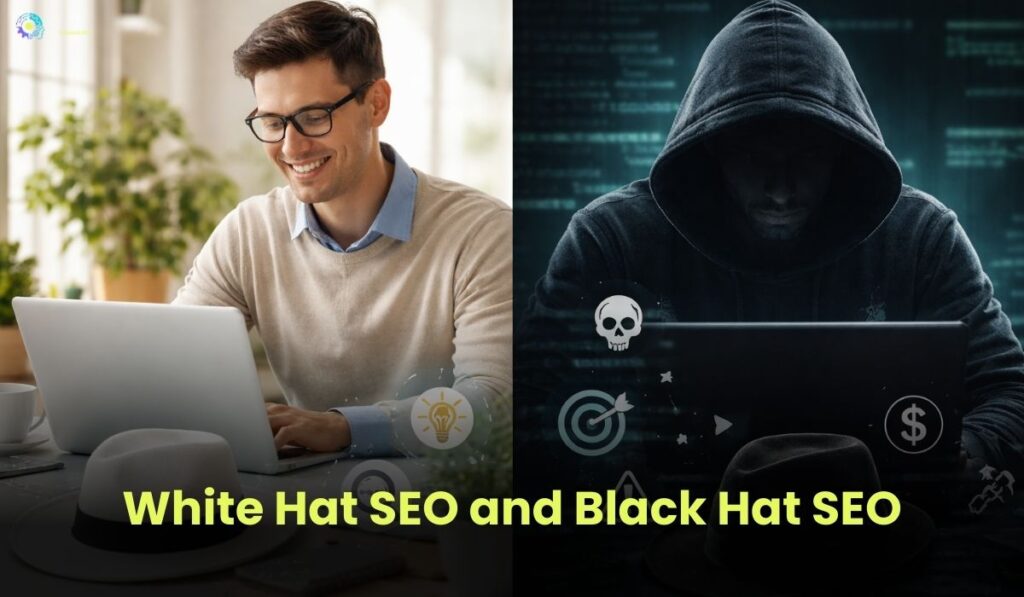
To answer the question, What is White Hat SEO?, we must look at it as the “human-first” approach. This strategy aligns perfectly with search engine terms of service. It focuses on providing genuine value, ensuring that when a user clicks on your link, they find exactly what they were looking for.
White Hat SEO is a long-term investment. It requires patience, but the rewards are stable rankings and a high level of trust from both Google and your audience. For any Best SEO agency in Delhi, this is the only acceptable way to manage a client’s digital reputation.
White Hat SEO Best Practices
- User Intent Optimisation: It isn’t enough to just use a keyword. You must understand why the user is searching. White Hat practitioners create content that answers that specific “why.”
- Technical Excellence: Using Technical SEO services ensures that your site is crawlable, secure (HTTPS), and has a clean XML sitemap. If the bots can’t read your site, the humans won’t find it.
- Authoritative Link Building: Instead of buying links, you earn them. Through off-page SEO services, you build relationships with other high-quality sites that naturally want to link to your helpful content.
- Semantic Content Design: Using On page seo services to structure your data with Schema markup helps search engines understand the context of your information, not just the raw text.
In 2026, the New Trends of White Hat SEO are dominated by “Information Gain.” Google’s latest updates prioritise content that adds something new to the internet—like original case studies or unique data—rather than just rehashing what is already there. Furthermore, Interaction to Next Paint (INP) has become a massive ranking factor, making “snappy” site performance a cornerstone of ethical SEO.
What is Black Hat SEO?
If you are asking What is Black Hat SEO?, imagine it as the “machine-first” approach. These techniques are designed to find and exploit weaknesses in the search engine’s code. The goal is to “trick” the algorithm into thinking a page is more important or relevant than it actually is.
While the results can appear overnight, the “crash” is equally fast. Black Hat SEO is high-risk and is generally used by sites looking for quick, short-term profits before their domain gets blacklisted.
Black Hat SEO Best Practices (To Avoid)
- PBNs (Private Blog Networks): This involves building a network of fake, expired domains just to link back to a main site. Google’s AI is now incredibly good at spotting these patterns.
- Article Spinning: Using software to take a single article and swap out words to create hundreds of “new” (but unreadable) versions.
- Negative SEO: This is a dark tactic where someone points thousands of spammy links at a competitor’s site to get them penalised.
- Automated Query Spams: Sending thousands of automated searches to Google to make a keyword appear “trending” so your site gets a temporary boost.
New Trends of Black Hat SEO
The New Trends of Black Hat SEO in 2026 involve AI-Generated Spam at Scale. Bad actors are using large language models to create “content farms” that produce thousands of pages per hour. Another emerging threat is AI Voice/Video Manipulations to fake E-E-A-T signals. However, Google’s “Evidence of Life” update was specifically designed to catch these non-human patterns.
Also Read: SEO principles to understand the foundational rules that separate ethical optimisation from risky, short-term tactics.
White Hat vs. Black Hat SEO
To help you visualise the risks and rewards, here is a detailed breakdown of how these two approaches stack up against each other in the 2026 search ecosystem.
Feature | White Hat SEO | Black Hat SEO |
Primary Goal | Solving user problems & intent. | Manipulating search algorithms. |
Google Guidelines | Fully compliant. | Deliberately violates. |
Growth Speed | Gradual, steady, and organic. | Instant spikes followed by crashes. |
Sustainability | High (builds long-term brand equity). | Low (high risk of permanent ban). |
User Experience | High-quality, fast, and helpful. | Poor, often confusing or spammy. |
Key Tactic | Technical SEO services & UX. | PBNs, cloaking, and hidden text. |
2026 Focus | Information Gain & INP optimisation. | AI-generated mass spam. |
Why The Ethical Path Wins Every Time
The difference between these two worlds comes down to Sustainability.
- Safety from Penalties: When Google releases a “Core Update,” White Hat sites often see a boost because they are the “good neighbours” Google wants to reward. Black Hat sites, however, live in constant fear of losing 100% of their traffic overnight.
- Conversion Rates: Black Hat SEO might get a user to your page, but because the content is usually poor, the user will leave immediately. White Hat SEO Best Practices focus on the user, meaning those who land on your site are much more likely to become paying customers.
- Brand Integrity: No reputable brand wants to be associated with “shady” internet corners. Using off-page SEO services to get featured in major publications builds a brand “Trust Moat” that no algorithm update can destroy.
Conclusion
The choice between White Hat and Black Hat SEO is ultimately a choice between building a legacy or chasing a ghost—and this is exactly why businesses working with the Best SEO agency in Delhi focus on ethical, long-term strategies instead of risky shortcuts. In 2026, when AI-driven discovery prioritises trust and intent, these shortcuts are faster paths to a permanent ban than they are to profit.
Table of Contents
Ready to
Work with us?
Frequently Asked Questions
Is "Grey Hat" SEO still a viable option?
Grey Hat involves tactics that aren’t strictly against the rules but aren’t exactly “clean” either (like aggressive internal linking). In 2026, the “Grey” area is shrinking. What worked as Grey Hat last year is often labelled as Black Hat today as Google’s AI grows more sophisticated.
Can I recover a site after a Black Hat penalty?
It is possible, but very difficult. You have to remove every spammy link, delete the low-quality content, and submit a “Reconsideration Request” via Search Console. It is often cheaper and faster to start over with a new domain.
Does the Best SEO agency in Delhi use Black Hat?
A truly professional agency will strictly avoid Black Hat. Their reputation depends on your long-term success. If an agency promises “guaranteed #1 rankings in 48 hours,” they are using techniques that will eventually destroy your domain.
How does AI play into White Hat SEO?
AI is a tool, not a replacement. Using AI to outline ideas, check grammar, or analyse data is 100% White Hat. Using AI to generate 5,000 pages of “fluff” without human editing is Black Hat.
What is the biggest risk of Black Hat SEO in 2026?
Beyond just a ranking drop, the biggest risk is “Permanent De-indexing.” In 2026, Google has moved toward “Zero Tolerance” for AI-spam, meaning your entire brand name could be wiped from the search engine forever.